Implicit memory is the part of long-term memory that works without conscious recall. It carries motor skills, habits, priming, and learned reflexes. A person can grow better at a task day by day while having no memory of practice. The learning happens. The remembering does not. It works in the background, below notice.
The sharpest evidence came from one patient. In 1953, Henry Molaison lost most of both medial temporal lobes, including the hippocampi, in surgery for epilepsy. New conscious memories stopped forming. Yet some of his skills kept improving. That split reshaped memory science.
The Mirror-Tracing Result That Redrew the Map
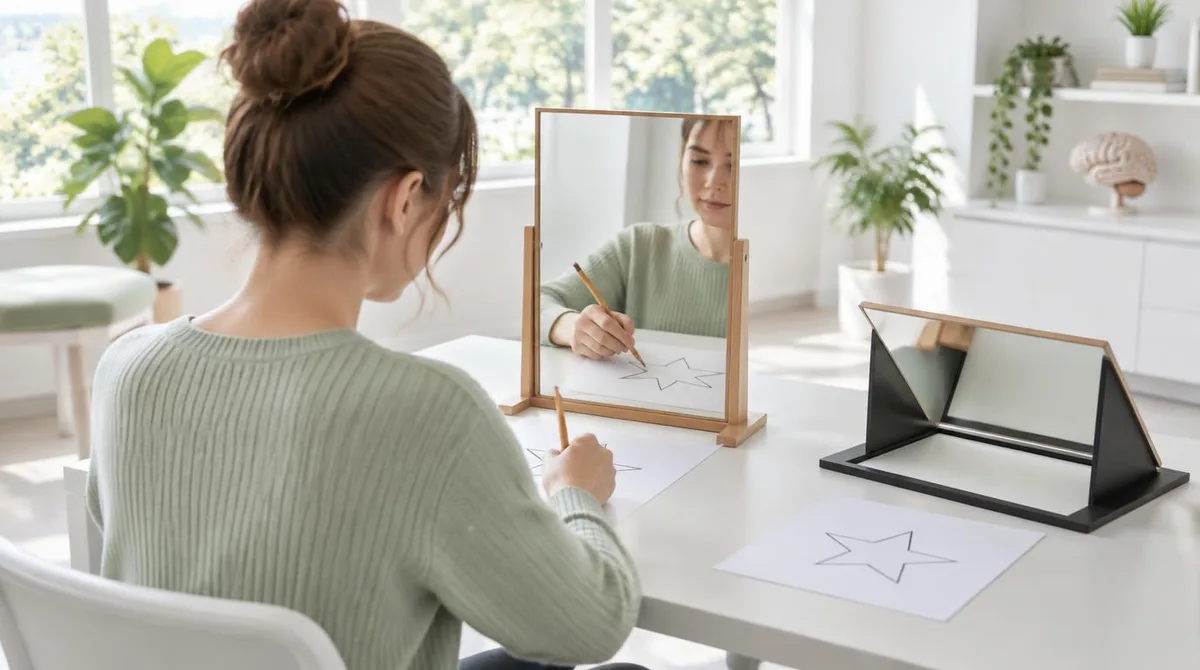
In the early 1960s, Brenda Milner gave Molaison, known in the literature as H.M., a star to trace. He could see it only through a mirror. The task feels odd at first, and everyone improves with practice. The mirror made the hand contradict the eye. His errors fell from about thirty on early trials to five or six by the tenth trial of day one. By day three he made almost none. Each session he called the task new. He had no memory of the sessions. His hands had learned anyway.
Milner concluded that motor systems outside awareness, tied to the basal ganglia and the cerebellum, can keep what the conscious mind drops. The result implied two memory systems with separate hardware. Hippocampus damage blocks one system and spares the other. The hands kept a skill. The mind kept no story of it.
Priming and Skills: The Scope of Implicit Memory
Priming is the most measured form. Earlier exposure speeds later work, with no deliberate recall involved. In a 1981 study by Jacoby and Dallas, priming on perceptual tasks appeared with no link to recognition. Priming also feeds the illusory truth effect. Statements feel true just because they are familiar. The effect holds even when people are told the statements were false.
Skill is the everyday form. Writing, bike riding, and typing run with no step-by-step control. Amnesic patients also learned the Tower of Hanoi puzzle and a pursuit-rotor task at normal rates. They denied any prior exposure. The learning went on. The practice sessions stayed out of reach. The skill curves looked normal. The reports of the practice did not exist.
Which Brain Systems Carry the Load
The hardware differs by task. The cerebellum processes procedural memories, such as piano fingerings. The OpenStax text lists the set plainly. Procedural skills, motor learning, and classical conditioning all survive without the hippocampus. In animal work, rabbits with damaged cerebellums failed to learn a conditioned eye-blink. Patients with Huntington's disease showed the mirror image of the amnesic pattern. Their priming stayed normal while their rotor learning failed. Two failures, in opposite directions, point to separate systems under one label. Conditioned responses belong here too. The rabbit eye-blink is the standard case.
What Implicit Memory Does Not Mean
The findings carry limits. Implicit memory is not stored in muscle. The label points to brain circuits, chiefly below the cortex and in the cerebellum. It is also not a hidden tape of everything. It covers set tasks, and each circuit can fail alone. Skill kept after amnesia does not make conscious recall unimportant. It means the two systems can be studied apart. We covered a connected angle in Semantic Memory: How the Brain Stores Facts, Meanings and Categories.
Conclusion: Learning That Never Needs Remembering
The hands of H.M. kept a record his mind could not open. Priming, skills, and conditioning now trace to their own circuits. The open question is exchange. How implicit and explicit systems share information during normal learning remains unknown. For now the lesson stands. Skill without recollection is not a trick. It is a second memory, running quietly beside the first.