Iconic memory is the brief visual store that holds a copy of what the eyes have just seen. It lasts a few hundred milliseconds, rarely past one second. It holds far more than can ever be reported. It is the visual half of sensory memory. Its discovery took one clever test.
In 1960, George Sperling asked a simple question. How much does the visual system take in during a single glance? The answer surprised the field. Nearly everything in view enters. Almost none of it can be used.
The Experiment That Made the Icon Visible
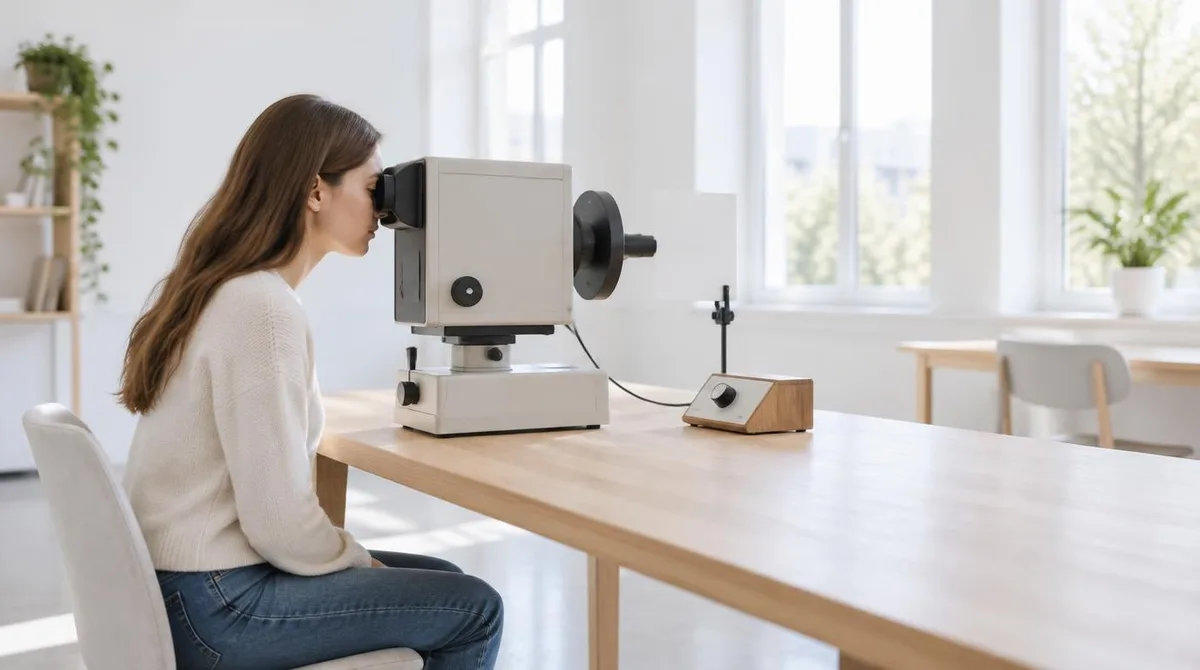
Sperling used a tachistoscope, a device that flashes images for set times. He showed arrays of letters, three rows of four, for fifty milliseconds. He tried three-by-three grids as well. The result held for both sizes. Fifty milliseconds is one twentieth of a second. In the whole-report task, viewers tried to name all twelve letters. They typically reported three to five. The limit looked like a limit of sight.
The partial-report task changed the question. A tone sounded right after the flash. One pitch stood for one row. The tone told viewers which single row to report. Cued this way, viewers recalled a row well on about three of four trials. If any row could be named at that level, most of the array must have been present at the moment of the cue. The bottleneck was not seeing. It was reading the trace out before it died.
How Fast the Icon Fades
Sperling then varied the delay of the tone. Performance fell sharply as the delay grew. Once the cue came about one second after the display, partial report no longer beat whole report. Common estimates place the useful life of the icon between two hundred fifty and five hundred milliseconds. Darkness stretches it slightly. The trace is broad, bright, and short.
From Result to Name
The result stood for seven years without a name. In 1967, Ulric Neisser coined the term iconic memory for the store the test had caught. The name stuck because the concept earned it. The term marked a claim. A store with its own speed, and its own death. Later work confirmed the picture. High capacity, fast decay, and a read-out slower than the store itself. For related coverage, see Implicit Memory: The Skills and Habits Formed Without Conscious Recall.
The store earns its keep in ordinary vision. A sparkler swung at night leaves a trail of light. That trail is the icon working in plain air. The brief overlap smooths what would otherwise arrive as separate instants. No lab gear is needed to see it. A single sweep of a bright light makes the point.
What Iconic Memory Is Not
Three clarifications prevent overreach. Iconic memory is not photographic memory. It is a pre-attentive copy that dies in fractions of a second, not a picture that can be revisited. It is not short-term memory, which holds a handful of items for many seconds with rehearsal. And it is not attention. Selection happens after the icon, not inside it. Speech cannot outrun the trace either. Naming takes seconds. The icon takes fractions of a second. The test showed a wide door, not a deep room. This connects to our earlier piece, Sensory Memory: The Fraction-of-a-Second Buffer Behind Every Perception.
Conclusion: The Trace That Outruns Speech
Sperling's numbers still anchor the field. Twelve letters in. Three to five out. A trace gone in under a second. What stays open is the hand-off. How the mind selects the one row, face, or word that survives the icon, and where that choice happens in the cortex, remains unsettled. The buffer is measured. Its exit rules are not. The icon holds the world. Choice holds the door.