
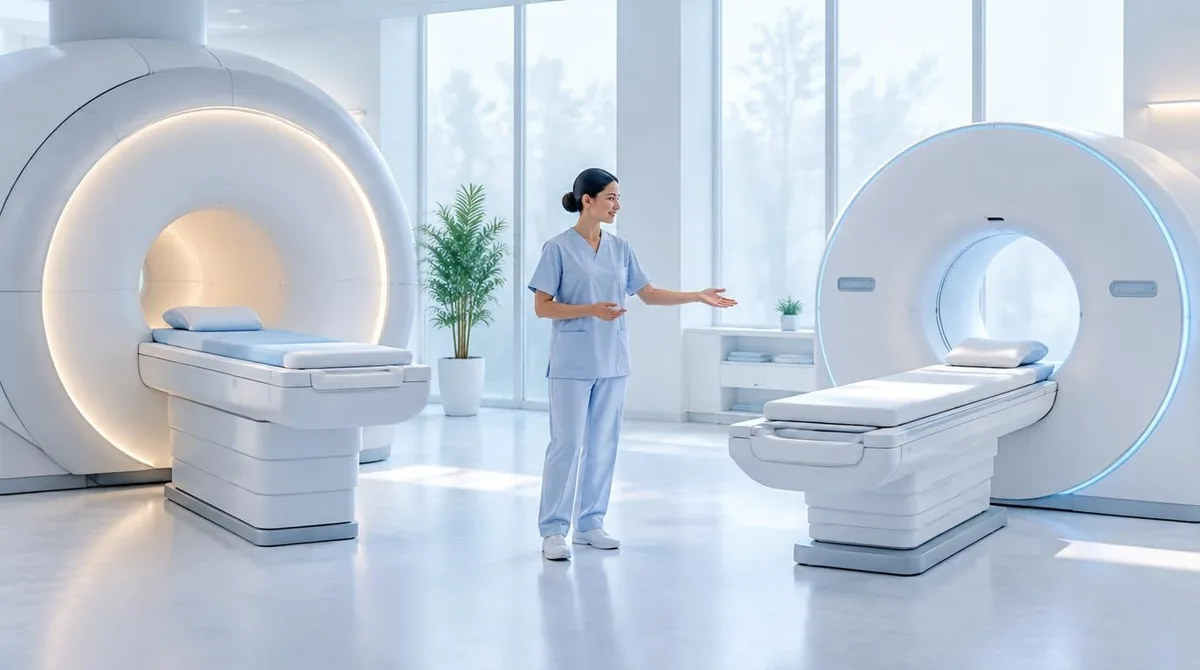
The difference between an MRI and a CT scan starts with the physics. A CT scan uses X-rays. An MRI uses a strong magnet and radio waves. That single distinction drives everything else: how fast each scan runs, what each shows well, what each costs, and who can safely have one.
Neither scan is simply better. According to MD Anderson Cancer Center, neuroradiologist Melissa Chen compares the two as complementary tools that give different kinds of information, not competitors on a quality scale. The right choice depends on the question the doctor is asking and the patient's own circumstances.
What does each machine actually use to make its picture?
A CT scanner, short for computed tomography, works like a series of X-rays taken very quickly in a circle around the body. Combined, those images form a detailed three-dimensional view. Because it relies on X-rays, a CT exposes the patient to a small dose of ionizing radiation.
An MRI, or magnetic resonance imaging, takes a different route entirely. A powerful magnet creates a constant magnetic field, and radio waves interact with the fat and water molecules in the body. As Healthline explains in its comparison of the two scans, the radio waves bounce off those molecules and a receiver translates the returning signals into an image. No radiation is involved at any point.
That contrast matters for safety. Radiation exposure is the main concern raised about CT scans, and it is a contested one. The FDA, as Cleveland Clinic notes, describes the cancer risk from CT radiation as being of statistical uncertainty based on current scientific knowledge. MRI carries no radiation risk, but its magnet rules out some patients: certain metal implants, including some pacemakers, defibrillators and shunts, are incompatible with the strong field.
Which scan shows what?
Each machine has a natural strength. CT excels at showing edges and structure: bones, kidney stones, gallstones, internal bleeding, organs and lungs. Cleveland Clinic quotes radiologist Albert Parlade describing CTs as good at looking at "bones and stones," and noting that surgeons often use them to plan operations, such as getting a three-dimensional view of a bone before repairing a complex fracture.
MRI is the soft-tissue specialist. It differentiates tissue types with high precision, which makes it the tool of choice for joints, nerves, the brain, the spinal cord, ligaments and masses found on other scans. Parlade points out that some nerves can be seen with MRI, including injury or inflammation in a nerve, while nerves are not directly visible on a CT.
MD Anderson frames the tradeoff in technical terms worth understanding. CT scans are better at spatial resolution, meaning they show where the edges of structures are. MRIs are better at contrast resolution, meaning they show the differences between tissue types, which helps abnormal tissue stand out from normal tissue. In cancer care specifically, MD Anderson states that CT is strong for lung cancer, while MRI is preferred for brain tumors and anything involving the spinal canal.
How do speed and cost differ?
Speed is where CT dominates. A typical CT scan takes less than a minute of actual scanning time; the preparation often takes longer than the scan itself, as MD Anderson's radiologist describes it. That makes CT the default in emergencies, where patients may be in pain or unable to hold still, and for urgent questions like internal bleeding, bowel blockages or fractures.
MRI demands patience. Scan times run roughly 20 to 50 minutes, and longer for extensive imaging. The patient must lie very still, because movement distorts the images and may force a repeat. The machine is also loud enough that earplugs or headphones are routinely offered. Healthline's comparison puts typical MRI durations at 20 to 90 minutes depending on the body area and whether images need retaking. For related coverage, see MRI vs CT Scan: How Each Machine Builds Its Image of the Body.
Cost follows the same pattern. Multiple sources agree that CT scans are more common and less expensive, while MRI produces more detailed images at a higher price. As Medical News Today summarizes, CT is more common because it costs less and still provides good detail, and doctors order MRI when they need more accurate, detailed images.
What this means for the two scans working together
The two scans are often used in sequence rather than instead of each other. A common pattern, described by Cleveland Clinic, is a full-body CT to spot tumors, followed by an MRI to characterize any masses in greater detail. MD Anderson's radiologist calls the MRI a problem-solving tool: when doctors see something uncertain on a CT, they may order an MRI to figure out what it is. We covered a connected angle in CT Scan vs MRI: What Each Machine Measures and When Doctors Choose It.
Contrast agents add another layer of difference. CT uses an iodine-based dye, which is not safe for people with an iodine allergy. MRI uses gadolinium-based agents, which require caution in people with kidney disease. In both cases the dye is given intravenously and makes certain features easier to see.
Who can and cannot have each scan?
Patient factors often decide the question before image quality does. Pregnancy pushes doctors away from CT because of radiation, though exceptions are made when a scan is judged absolutely necessary; Medical News Today notes that doctors may recommend MRI or ultrasound instead, while still using MRI cautiously in the first trimester as a precaution.
Metal is the MRI gatekeeper. Patients are asked to disclose any implant, including pacemakers, artificial joints, eye implants, IUDs and stimulators, before an MRI. MD Anderson adds a less obvious screening point: people with a history of metal-working, or with embedded foreign bodies such as bullet fragments or shrapnel, must also be flagged, because iron-based material could move inside the body in the magnetic field.
Comfort matters too. Claustrophobia makes MRI difficult for some patients, though open MRI scanners exist to address this. Patients who cannot lie still for the length of an MRI are often better served by a fast CT.
The open question: which scan, for which patient?
The evidence here points to one conclusion: the difference between MRI and CT is a difference of instrument, not of rank. CT answers questions about structure quickly and cheaply, with a small radiation dose. MRI answers questions about tissue slowly, in detail, with no radiation but strict metal screening. For readers following imaging technology, the interesting frontier is not which machine wins but how radiologists sequence the two, and how the choice shifts as scanner designs and safety screening evolve. The honest answer to "which is better" remains the one the sources give: it depends on the doctor's question and the patient in front of them.