Echoic memory is the auditory sensory store. It holds sound for roughly two to four seconds after the sound has ended. That is long enough for a sentence to be understood after its final word arrives. The store encodes basic features, such as pitch and where a sound came from. Its job is brief custody, not meaning.
Hearing poses a problem that vision does not. Speech unfolds over time. Meaning often hangs on the end of a phrase. Without a buffer, the opening words would be gone before the closing ones could finish them. Echoic memory is that buffer. We covered a connected angle in Iconic Memory: The Visual Buffer George Sperling Caught in 1960.
The Three-Speaker Test of 1972
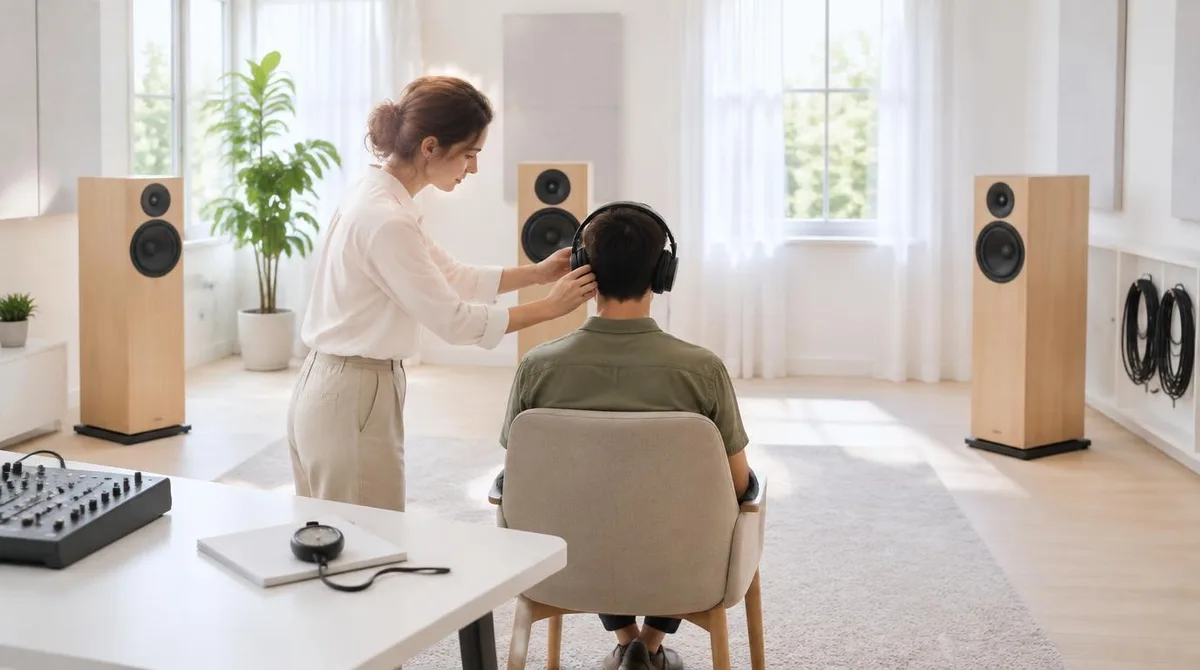
The store was measured with an auditory copy of Sperling's method. In 1972, Darwin, Turvey, and Crowder played three lists of items at once. One list went to the left ear. One went to the right. One went to both ears at the same time. The setup created three spatial channels. A cue after playback told listeners which channel to report. Partial report of one channel beat whole report by a wide margin. Recall for spatial location also beat recall for meaning. Performance fell as the delay before the cue grew. The design mapped the store's life in seconds, not milliseconds. The task looked odd. The logic was Sperling's logic, moved to the ear.
How Long the Echo Lasts
Estimates of duration vary with method. Typical figures run three to four seconds. Some work places the useful window at two to three seconds. Early estimates split. Guttman and Julesz put the hold near one second. Eriksen and Johnson stretched it toward ten. The contrast with the visual store is stark. The icon survives under one second. The echo survives several, because sound needs the extra time. A store measured in seconds can bridge a whole spoken phrase. Readers following this should also see Sensory Memory: The Fraction-of-a-Second Buffer Behind Every Perception.
Capacity is broad in a different way. The store holds a large amount of auditory information, but only for a moment. It does not hold complex meanings. It keeps sounds, not messages. The work runs through the temporal lobe, the brain's hearing ground.
Why Speech Needs the Buffer
The buffer explains several plain effects. The final words of a sentence can settle the sense of the opening ones. The whole phrase still sits in the store when the last word lands. Sounds from different directions stay separate long enough for later stages to pick one. The store keeps pitch and location attached to each sound, and parsing leans on that information. Each effect rests on sound being held after arrival, not on attention being fast. Location rides along with the trace. A sound stays findable by its place for a moment after it stops.
What Echoic Memory Does Not Do
Limits deserve equal billing. Echoic memory is not a recording. Nothing is kept for later inspection beyond a few seconds. It is not working memory, which holds a small set of items with active effort. And it is not understanding. It holds raw material long enough for later systems to parse it. That custody is its whole role. Effort can stretch working memory. Nothing stretches the echo by much.
Conclusion: The Mind's Short Replay
Darwin's three-speaker test and its heirs fixed the numbers. Seconds, not milliseconds. High capacity, with no meaning attached. The open question is the boundary. How much of speech processing runs inside the echo, and how much starts only after the hand-off, remains unknown. The replay is real, brief, and measured. What the mind does with the replay is still being worked out.