Context dependent memory is the finding that the surroundings at learning become part of the memory itself. Recall tends to improve when the place of retrieval matches the place of study. The effect is real, and it has a famous origin story. It is also easy to break. That fragility is the most instructive part.
The cleanest early demonstration involved neither classroom nor scanner. It involved wet suits. In 1975, two psychologists took word lists to the sea. The experiment that resulted still anchors this corner of memory science. We covered a connected angle in Implicit vs Explicit Memory: Two Systems, One Brain.
The diving study that started the field
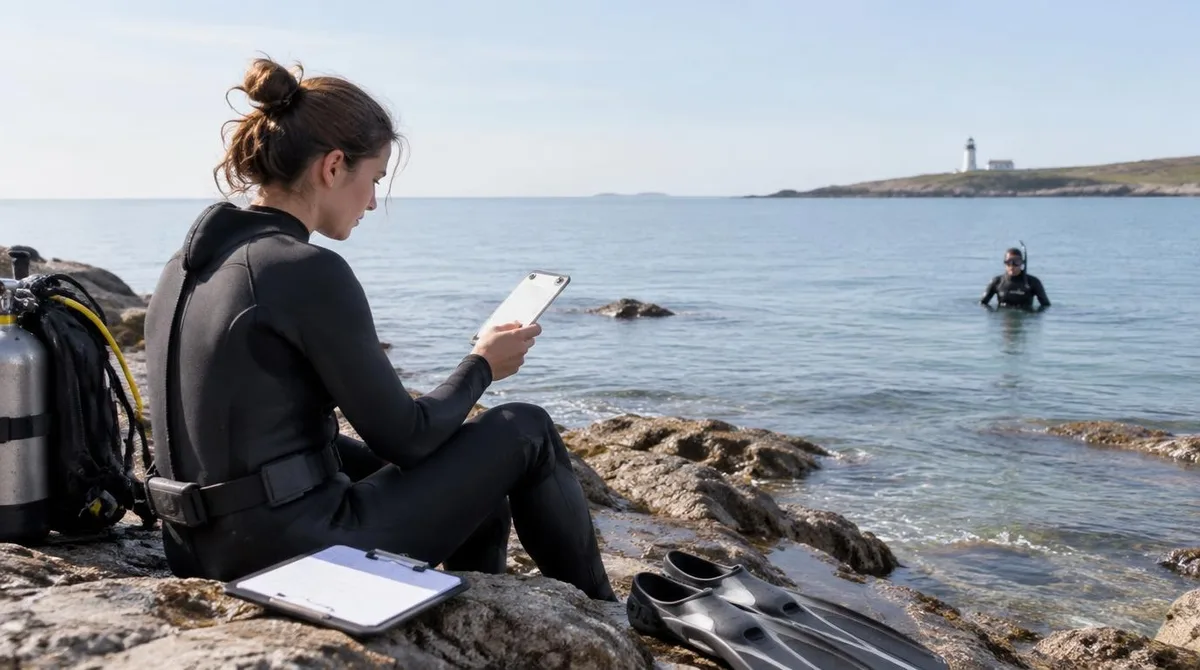
Godden and Baddeley built two natural settings. One was dry land. The other was the sea floor. Deep-sea divers learned word lists in one setting. They then recalled the lists in the same setting or in the other. The result was tidy. Word lists learned underwater came back best underwater. Lists learned on land came back best on land. Mismatched settings produced reliably worse recall. Readers following this should also see Neuroscience Jobs Today: Where the Degree Actually Leads.
The study mattered because the settings were real, rich, and unmistakably different. A lab room and another lab room differ by a poster. Land and water differ by almost everything a body can sense.
Context dependent memory as a retrieval cue
The usual explanation treats the environment as a cue. The rule is simple. Recall works best when the retrieval setting resembles the learning setting. The place works like a label attached to the file. Return to the place, and the label helps pull the file out.
The effect is not confined to words. A 2021 study tested motor sequences. The same logic showed up in movement. What the hands learned in one context returned more smoothly in that context. Place, it seems, can tag skills as well as lists.
A replication that came back empty
Fragility showed up early in the field's history. In 2003, medical researchers repeated the diving logic in a hospital school. Sixty-three medical clerks learned a word list and a patient case. The settings were a classroom and a bedside. Recall then took place in the same setting or the other one.
No significant same-context advantage appeared. The authors urged caution against over-generalizing the diver study. Physical setting alone may matter little, they argued. Other forms of context might still carry weight.
When the effect grows strong, and weak
A meta-analysis of the field explained the scatter. Across studies, the effects were reliable. They shrank under two conditions. Strong non-contextual cues at learning overshadow the setting. Strong cues at test outshine it. Mentally replaying the original setting also weakens the effect. Attention turns inward. The room stops mattering.
Recent work adds a sharper rule. The effect has proved difficult to reproduce in ordinary lab settings. One virtual-reality design used two distinct worlds. One was an underwater reef. The other was a Mars station. The effect returned. Recall was better in the matching world. The advantage grew for items that fit the world's schema. Context appears to work when the mind files items into a scene.
Conclusion: the room is one cue among many
Context dependent memory survives as a genuine but conditional phenomenon. Place can serve as a retrieval handle. It works best when the place is vivid and the memory lacks better cues. What remains open is proportion. In ordinary life, rooms change and cues abound. No meter yet says how much daily recall leans on the walls.