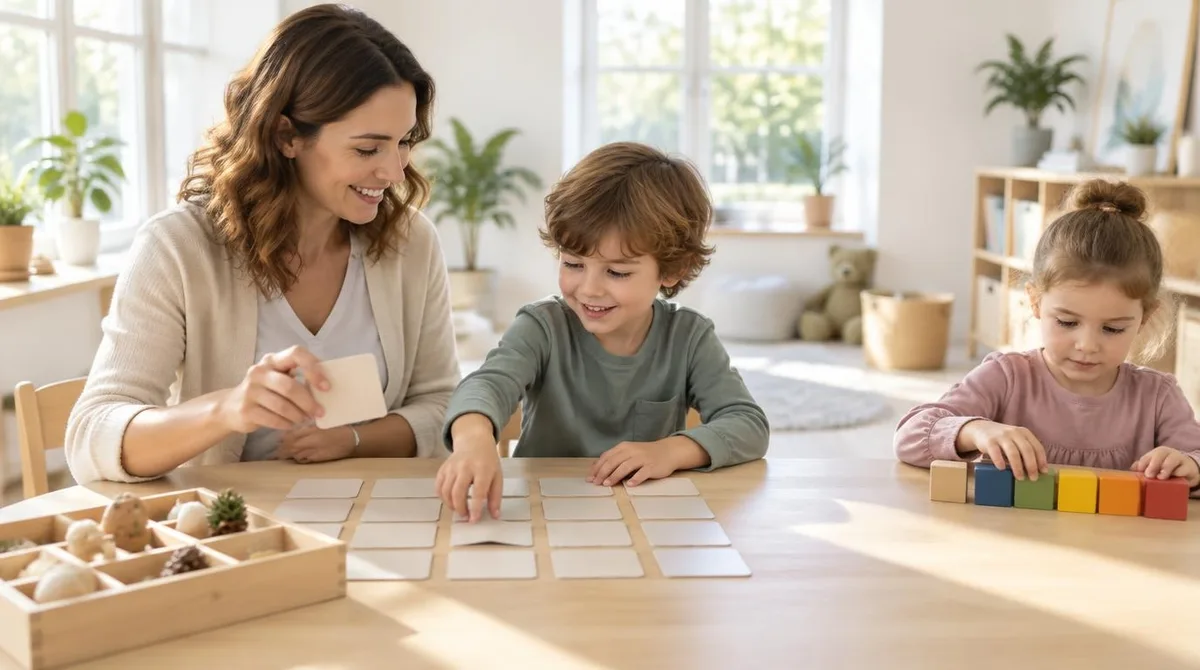
The best memory games for kids are not the ones with the boldest claims. They are the ones that make a child hold facts in mind, link them and call them back while playing. A matching card game hides pairs and demands tracking. A sequence game adds one step at a time and tests recall under mild pressure. Story games ask a child to rebuild events in order. Each trains a distinct skill, and the fun carries the load.
Play science backs the idea that games are real work for a growing brain. A Scientific American review gathered evidence that free, imaginative play builds language, thinking skills and social skill. The limits deserve equal airtime, and this guide gives them their own section.
What the best memory games for kids train
Three skills stand out. Working memory holds a small store of facts for instant use, like the positions of two unmatched cards. Paired-associate learning links two items, the heart of every matching game. Recall in order rebuilds sequence, the engine of pattern games and retold tales. None of it needs screens. A card deck, a tray of objects and a told story cover the whole kit. This connects to our earlier piece, Semantic Memory: How the Brain Stores Facts, Meanings and Categories.
Ages one to four: hiding, naming, stacking
The first memory games are talks. Harvard's Center on the Developing Child describes serve and return: lively back-and-forth swaps between a young child and a caring adult. A babble gets a word. A point gets a name. These swaps strengthen the neural links that shape brain growth. Naming what a child sees or does builds language before speech arrives. Simple hiding games add object memory. Blocks add spatial work. In one study of toddlers given toy blocks, the children scored higher on language tests after six months than peers without them. Turn-taking games with cups fit here too. Hide a toy under one of three cups. Move them slowly. The child tracks the moves and finds the prize. This connects to our earlier piece, Memory Care Facilities: What They Are and How to Evaluate Them.
Ages five to nine: rules, rounds, sequences
School-age children handle structured play. Classic pairs scale up with more cards and more players. Simon-style pattern games stretch recall one step at a time. Twenty questions trains holding a category in mind while guessing. Retelling a story in order, then changing one detail, turns narrative into a memory task. Free play still matters here. A 1973 study found that children who freely explored objects later named about three times as many novel uses for them as children who copied an adult. Card pairs with themed decks add words to the mix. Animal decks, flag decks and number decks all work. Older children can deal and keep score themselves. For related coverage, see False Memory OCD: How Intrusive Doubt Hijacks Recollection.
What no game can deliver
Here the evidence turns sober. A synthesis covering 87 papers on computerized working memory training found short-term gains on the trained tasks alone. It found no solid evidence of gains in reading, math or other distant skills. Practice strengthens what is practiced. Games that promise general intellect oversell. Play stays valuable for social, emotional and physical growth; the memory claims deserve modesty. One university review even concluded that play may mark healthy growth rather than drive it, though many researchers hold both views. One practical edge follows all the same. A game a child enjoys and replays beats a drill that breeds dread.
Conclusion: pick the game, skip the claim
The best memory games for kids make a child notice, hold and relink facts, and the child wants to keep playing. Age sets the ceiling, not the brand. What stays open is mechanism. Researchers still differ over which parts of play drive cognitive growth. That leaves the game shelf one of the few places where fun and science already agree. The shelf need not be deep. Depth of play beats breadth of apps.